
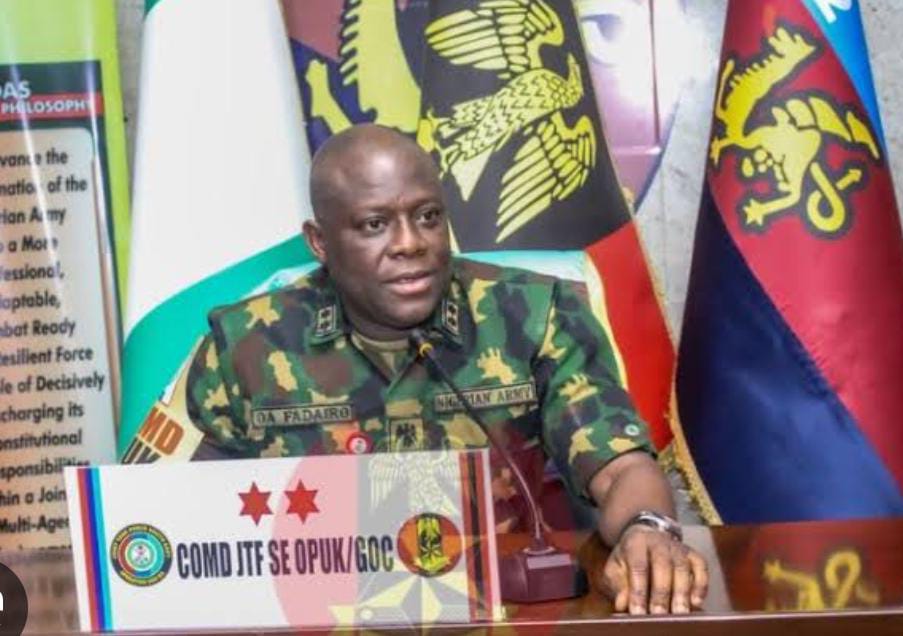
The Fadairo Effect: Sustaining the Fight, Rewriting the Security Story in South-East
By Chidi Omeje
There is a tendency to measure military leadership solely by the number of operations conducted, arrests made or weapons recovered. But the more consequential test of a commander is whether he can convert military capability into sustained security, operational stability and strategic advantage.
By that broader measure, the leadership of Major General Oluremi Ayobami Fadairo, General Officer Commanding 82 Division, Nigerian Army, and Commander of Joint Task Force South-East, Operation UDO KA, deserves closer attention. At the heart of Fadairo’s command philosophy is a simple but consequential principle: criminal and separatist threats must not be allowed the breathing space to regenerate. This explains his emphasis on continuous military pressure, intelligence exploitation, aggressive patrols and targeted clearance operations across the Division’s Area of Responsibility.
The significance of this approach cannot be overstated. The South-East security challenge is not a conventional battlefield. It is an asymmetric environment in which criminal networks exploit difficult terrain, local grievances, fear and community vulnerabilities. Such an environment demands more than firepower. It requires intelligence, mobility, persistence, inter-agency coordination and the ability to anticipate how adversaries adapt. Maj Gen Fadairo appears to understand this distinction.
Under his watch, troops have continued to conduct intelligence-driven operations designed not merely to confront armed elements but to degrade their operational infrastructure, dismantle hideouts and restrict their freedom of action. The result, according to the Army, is a relatively stable security environment across the Division’s Area of Responsibility. That stability is itself an achievement.
In counter-insurgency and counter-criminal operations, the absence of spectacular headlines can sometimes obscure the importance of sustained security gains. When criminal groups lose the capacity to move freely, establish camps, launch attacks at will or intimidate communities with impunity, the security environment changes fundamentally. The real measure of success, therefore, is not simply how many battles are fought. It is whether the adversary is progressively denied the ability to dictate the terms of engagement. This is where Fadairo’s insistence on continuous operational assessment and adaptive security responses becomes particularly important.
A commander who believes yesterday’s victory is sufficient, risks allowing the adversary to regroup tomorrow. Fadairo’s stated preparations for intensified dry-season operations under Operation EASTERN SANITY II suggest a leadership philosophy built around maintaining operational momentum rather than celebrating temporary gains. That is strategically significant. Security operations are rarely won in a single decisive encounter. They are won through sustained pressure that progressively reduces an adversary’s options until its ability to operate is severely constrained.
But perhaps one of the most revealing aspects of Gen Fadairo’s leadership is his understanding that military operations must generate institutional knowledge. His engagement with participants of Army War College Nigeria Course 10/2026 illustrates this dimension. Rather than treating the operational theatre merely as a place where troops fight, the command exposed the participants to the realities of the South-East theatre through operational briefings, sector visits, wargaming exercises, presentations on achievements and challenges, and visits to the National War Museum. This is leadership beyond the immediate battlefield.
Read Also:
The South-East theatre is effectively becoming a laboratory of contemporary security challenges where conventional military capability intersects with asymmetric warfare, criminality, intelligence operations, community dynamics and peace-building. By sharing operational experiences and lessons learned with future military strategists, the 82 Division under Maj Gen Fadairo is contributing not only to today’s security campaign but also to the Nigerian Army’s institutional capacity to confront tomorrow’s threats.
There is another important dimension to Fadairo’s approach: proactivity. His message to the War College participants that security forces must remain proactive and intelligence-led, reflects an understanding that the most effective security operation is often the one that prevents an attack before it happens. This requires moving from reaction to anticipation; from waiting for criminal elements to strike to identifying their intentions, networks, logistics and possible operational footholds before they become established.
That philosophy is particularly relevant in the South-East, where preventing the re-emergence of criminal strongholds is arguably as important as dismantling existing ones. Guided by the Chief of Army Staff, Lt Gen Waidi Shaibu’s command philosophy, the GOC has always emphasised lawful and decisive military action. That balance matters. The legitimacy of military operations is inseparable from the professionalism with which they are conducted. The Nigerian Army’s mandate is not simply to defeat threats but to do so within the framework of the law while protecting innocent citizens and preserving public confidence.
His insistence on coordination with other security agencies and relevant stakeholders equally reflects the reality that no single institution can solve Nigeria’s complex security challenges alone. The Army can clear territory, disrupt armed groups and provide the force required to confront serious threats. However, lasting peace requires intelligence cooperation, effective policing, community engagement, economic opportunity, justice and good governance.
The military can create the security space. Other institutions must help consolidate it. That is why Gen Fadairo’s leadership should be viewed within the larger context of stabilising the South-East rather than simply fighting separatist groups. The ultimate objective is not perpetual military deployment. It is an environment in which citizens can travel, trade, work and live without fear; where criminal networks cannot hold communities hostage; and where the state retains the unquestioned capacity to protect its citizens.
The challenge before Fadairo and his troops is therefore substantial. Residual threats remain. Criminal networks can mutate, relocate and exploit emerging vulnerabilities. Operational successes must be consolidated, not assumed to be permanent.
But the trajectory matters. A relatively stable operational environment, degraded criminal capabilities, disrupted hideouts, restricted freedom of action and preparations to sustain pressure during the dry season all point to a command determined not to surrender hard-won gains.
That may ultimately be the most enduring footprint of Major General Fadairo’s leadership: not simply defeating threats when they emerge, but building the operational conditions under which those threats struggle to return. For a region that has endured years of insecurity, that is no small accomplishment.
And for the Nigerian Army, the Fadairo approach offers an important lesson in contemporary command: victory is not merely the defeat of an adversary; it is the sustained denial of the adversary’s ability to threaten society again.
Kudos to Maj Gen Fadairo and his troops.
*Chidi Omeje is the publisher of Security Digest magazine.