Nigeria Hosts Regional Security Conference to Tackle Emerging Terrorist Threats in West Africa, Sahel
By Chidi Omeje
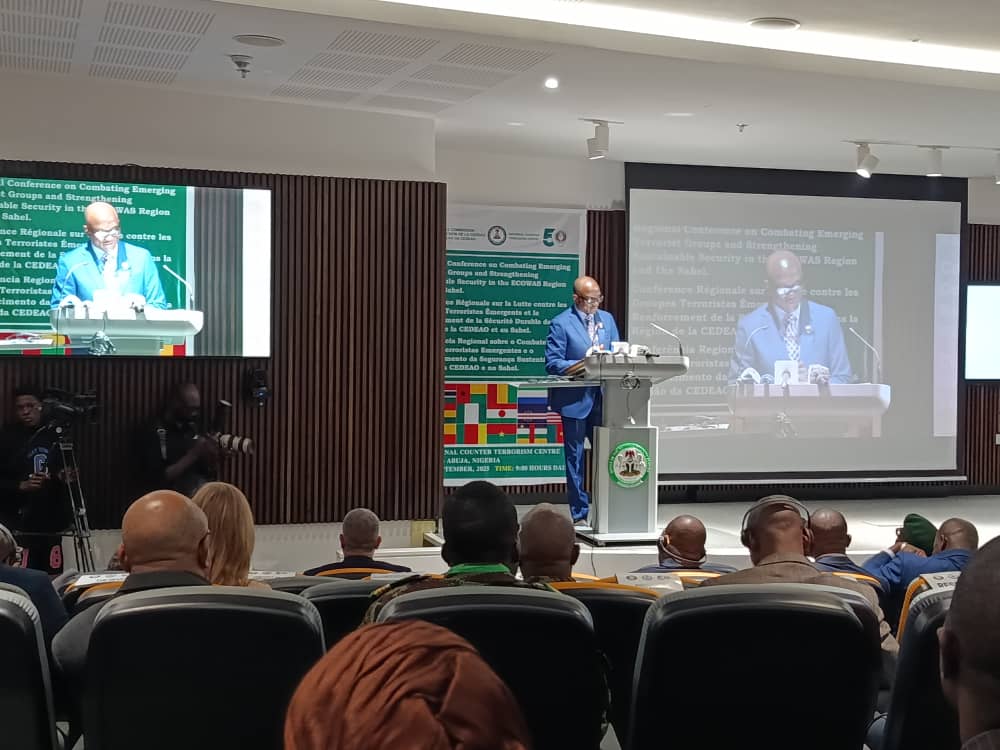
Nigeria has reaffirmed its commitment to regional security cooperation as it hosts a high-level conference on combating emerging terrorist groups and strengthening sustainable security across the ECOWAS region and the Sahel.
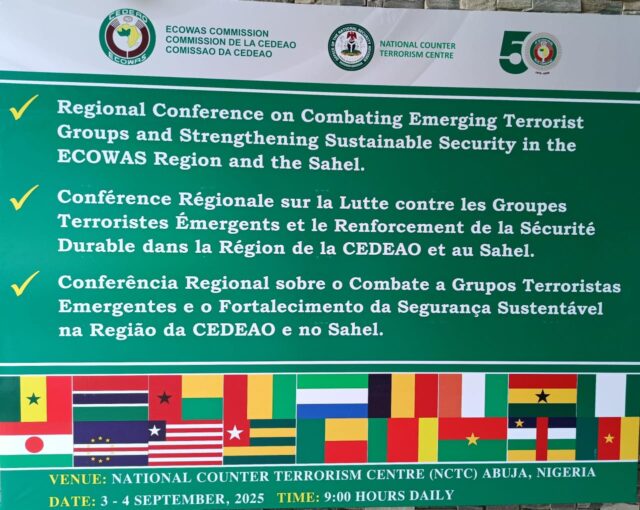
Welcoming the participants, the National Coordinator of the National Counter Terrorism Centre (NCTC), Maj Gen Adamu Garba Laka, said the gathering responds directly to the escalating threats posed by terrorist groups including Boko Haram, ISWAP, JNIM, AQIM and the recently identified Lakurawa group.
He warned that these groups are exploiting porous borders, weak governance structures, and new technologies to expand operations, radicalize youths, and destabilize communities. “The evolving threat demands resilience, innovation, and stronger cross-border collaboration,” he stated.
While declaring the conference open, Nigeria’s Minister of Defence, Mohamed Badaru Abubakar, said the fight against terrorism is not only a battle for security. “It is a struggle for the very future of our societies. It is about protecting our people, preserving our values,and ensuring that our region emerges as a beacon of resilience.We must envision an ECOWAS and Sahel where regional cooperation is a model for the world, where our response to terrorism is coordinated, effective, and firmly rooted in the aspirations of our people”.
“The future of our region depends on the choices we make today. This conference must not end with words on paper. It must deliver an actionable roadmap that strengthens partnerships,deepens collaboration and secures a future of peace, stability and shared prosperity. This conference should serve as a launchpad for bold ideas and decisive action”.
In his own remarks, the Chief of Defence Staff, Gen CG Musa, ably represented, stated that while battlefield victories are necessary, we know that they alone cannot guarantee lasting peace.
Read Also:
“Sustainable security requires strategic-level cooperation. This is why conferences such as this one are so crucial: they provide a platform to harmonize doctrine, improve interoperability, and ensure that our collective responses to terrorism are both effective and sustainable. Equally important is the need to complement kinetic operations with non-kinetic measures, ranging from civil–military cooperation to counter-radicalization, peacebuilding, and humanitarian support for affected communities”.
The two-day conference, organized in partnership with the ECOWAS Commission, follows resolutions of the December 2024 ECOWAS Extraordinary Summit, which called for the operationalization of a regional counterterrorism force, sustainable funding, and enhanced intelligence sharing. It also aligns with Nigeria’s National Counter Terrorism Strategy and the ECOWAS Plan of Action.
The NCTC Coordinator, Maj Gen Laka, further emphasized that sustainable security must go beyond military responses to address root causes of violent extremism through education, economic empowerment, social cohesion, and rehabilitation of disengaged fighters. He disclosed that Nigeria has secured 775 convictions from terrorism trials and continues to invest in non-kinetic measures such as community engagement, deradicalization, and victim support programmes.
He further highlighted Nigeria’s role as a Regional Centre of Excellence for Counter Terrorism, following the Abuja Declaration of April 2024, and noted ongoing capacity-building collaborations with institutions in Ghana, Côte d’Ivoire, and Egypt.
The conference is expected to produce a comprehensive situational analysis of new terrorist threats, a roadmap for strengthening border security and intelligence sharing, strategies for involving youth and civil society in counter-extremism efforts, and a communiqué with actionable recommendations for regional governments.
“For Nigeria, this fight is not abstract; it is lived daily,” the Coordinator stressed, paying tribute to the resilience of security forces and local communities. He also acknowledged the support of ECOWAS, the African Union, the United Nations, and international partners in the collective fight against terrorism.
The conference brings together senior defence officials, regional leaders, international partners, civil society, and security experts to chart a united response to the evolving security landscape in West Africa and the Sahel.