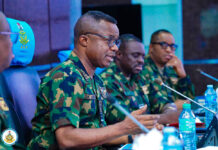

Waidi’s Soldier-First Agenda: How Welfare is Rebuilding Troops’ Morale
By Chidi Omeje
In the Nigerian Army, where men and women routinely confront danger in the defence of the nation, the question of morale cannot be treated as a peripheral issue. It is central to combat effectiveness. A soldier may possess the finest weapon, the best tactical training and the strongest sense of duty, but the human factor remains decisive. Behind every uniform is a human being with a family, aspirations, fears and a legitimate expectation that the institution he or she serves will also care for their welfare.
It is against this backdrop that the emerging emphasis on welfare under the Chief of Army Staff, Lieutenant General Waidi Shaibu, deserves attention. At the heart of the COAS leadership philosophy is the principle that the soldier must come first. More than a slogan, this philosophy which was first espoused by the immediate past Chief of Army Staff and currently the Chief of Defence Staff, Gen Oluyede, is increasingly being reflected in investments aimed at improving the living conditions, operational support and overall well-being of personnel and their families.
The significance of this approach lies in its potential effect on morale. In fact, there’s no better force multiplier than the welfare of the soldier, and so for troops deployed across Nigeria’s challenging security theatres, welfare is not merely about comfort; it is a veritable force multiplier.
A soldier who knows that his family is adequately catered for, that decent accommodation awaits him, that his children and spouse can benefit from support programmes, and that the Army is concerned about his welfare is likely to approach his duties with a stronger sense of institutional belonging. This is why the COAS’s focus on housing and infrastructure, for instance, is particularly significant.
The inauguration of post-service housing developments in Abuja represents an investment beyond the immediate needs of serving personnel. It speaks to the long-term socio-economic security of soldiers and their families and offers personnel the reassurance that their years of service can translate into some measure of stability after retirement. Similarly, the commissioning of newly completed blocks of officers’ flats at Ribadu Cantonment, Kaduna, and the commencement of the second phase of the Bola Ahmed Tinubu Barracks in Asokoro, Abuja, point to an effort to address accommodation challenges within the military community.
Across the operational formations, the directive for additional troop accommodation and upgraded medical facilities is equally important. For soldiers serving in difficult and often remote environments, decent accommodation and access to functional healthcare are not luxuries. They are essential components of a professional fighting force.
Perhaps one of the most consequential aspects of the emerging welfare orientation is the recognition that soldier welfare cannot end with the soldier. The well-being of a military family inevitably affects the peace of mind of the person serving at the frontline. Plans for family-focused skill acquisition centres and other support structures around military barracks have significance beyond their immediate economic benefits. They provide families with opportunities for empowerment and self-reliance while strengthening the social ecosystem around military communities. This is an important shift in thinking: caring for the soldier also means caring for the people who make it possible for the soldier to serve.
Read Also:
The noble profession of the military is without doubt a demanding one. For troops engaged in sustained counter-insurgency and internal security operations, prolonged exposure to danger, separation from families and the psychological demands of combat can take a toll. That makes recreational and social infrastructure relevant to military effectiveness. The commissioning and renovation of facilities such as the Nightingale Club at 1 Women Battalion, Giri, Abuja, may appear modest when compared with major military hardware acquisitions. Yet their importance should not be underestimated. Such facilities provide spaces for relaxation, social interaction and unit cohesion. They create opportunities for personnel to decompress and reconnect with colleagues and families after demanding assignments. In an institution where discipline and operational readiness are paramount, there must equally be room for healthy recreation and psychological recovery.
I have no doubt that welfare and operational readiness are two sides of the same coin. Interestingly, the COAS’s welfare agenda appears to extend beyond conventional welfare provisions to include the tools soldiers need to perform their duties safely and effectively. The refurbishment and deployment of operational and logistics vehicles illustrate this intersection. A soldier sent into an operational environment without reliable mobility is exposed not only to avoidable danger but also to operational limitations. Functional vehicles improve mobility, logistics, response time and the ability of commanders to support troops in the field. In this sense, providing a soldier with a serviceable vehicle is also a welfare intervention because it enhances his safety and operational effectiveness.
This is ultimately where the “Soldier First” philosophy will be judged; not simply by the number of buildings commissioned or vehicles refurbished, but by whether personnel increasingly feel valued by the institution they serve.
Across a military spread over numerous formations and operational theatres, morale is difficult to quantify through a single metric. But institutional attention to accommodation, healthcare, family welfare, recreation, mobility and post-service security sends an important message to the rank and file: your sacrifice is recognised, and your welfare matters. That message can have profound consequences.
The Nigerian Army is asking its personnel to confront some of the country’s most dangerous security challenges. Soldiers are deployed far from their families and, in many cases, operate under conditions that most Nigerians will never experience. If the institution responds by demonstrating that it is equally committed to their welfare, it strengthens the bond between the soldier and the Army.
The true test of any welfare policy is sustainability. Projects must be completed, maintained and equitably distributed. Medical facilities must remain functional. Housing must continue to expand. Family-support programmes must become institutional rather than occasional interventions. Recreational facilities must be properly managed, while operational platforms must be maintained throughout their service life. Our gallant soldiers deserve no less.
By placing the soldier at the centre of his leadership philosophy, Lieutenant General Waidi Shaibu appears to be making a fundamental point: you cannot demand extraordinary sacrifice from troops while treating their welfare as an afterthought. A professional army requires professional care for its personnel.
Ultimately, the fight against insecurity is not only about weapons, platforms and tactics. It is also about the human beings who carry the weapons, operate the platforms and execute the tactics. When those men and women know that the institution stands behind them, and that their families and future matters, the effect can reach far beyond the barracks. It can strengthen confidence. It can reinforce loyalty, and it can improve cohesion and discipline. Most importantly, it can translate into the morale and fighting spirit required to keep the Nigerian Army ready for the difficult task of defending the nation.
That is perhaps the deeper meaning of “Soldier First”: putting the welfare of the man behind the uniform at the heart of the Army’s readiness to defend Nigeria. Kudos to Lt Gen Shaibu and his team.
*Chidi Omeje is the publisher of Security Digest