Owning the Skies and the Consequences: Why the NAF’s Response in Silame Reflects True Professionalism
By Chidi Omeje
In modern counter-terrorism warfare, especially against shadowy, irregular forces embedded within civilian populations, perfection is an illusion.
Air power remains one of the most decisive tools against terrorists, bandits and insurgents, yet it is also one of the most complex and morally demanding instruments of state power.
Errors, however tragic, are sometimes an unintended by-product of this difficult battlespace. What ultimately distinguishes a professional air force from a reckless one is not just the absence of mistakes, but the courage, transparency and responsibility with which those mistakes are confronted.
This is where the Nigerian Air Force (NAF) deserves sober commendation.
Barely a year after the heartbreaking Christmas Day 2024 incident in Silame Local Government Area of Sokoto State, where an erroneous airstrike claimed the lives of 12 innocent civilians, the NAF has demonstrated a commendable sense of institutional accountability.
Rather than retreat into denial, deflection or bureaucratic silence, the NAF chose the harder but more honourable path: it accepted full responsibility.
In a country where public institutions are often accused of evading blame, the NAF’s conduct stands out. The joint compensation of ₦51 million by the Nigerian Air Force and the Sokoto State Government shouldn’t just be seen as merely about money; it is rather a symbolic acknowledgment that civilian lives matter, that grief deserves recognition, and that the uniform does not place anyone above moral responsibility.
Air operations in counter-terrorism campaigns are among the most technically and ethically demanding forms of warfare. Targets are fleeting, intelligence is imperfect, and adversaries deliberately hide among civilians to exploit precisely such tragedies for propaganda. In this fog of war, unintended mishaps, while deeply painful, are sometimes unavoidable. What matters is how a force learns, adapts and restores trust afterward.
Read Also:
By openly admitting that the Silame airstrike was a “grave operational mistake,” the NAF reaffirmed a critical principle of professional militaries worldwide: accountability strengthens legitimacy.
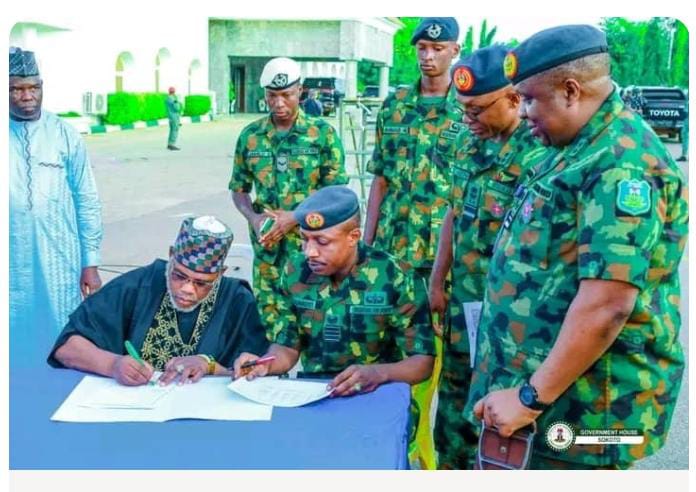
NAF’s Chief of Civil Military Relations, Air Vice Marshal Edward Gabkwet, who led the high-powered delegation to Sokoto on behalf of the Chief of Air Staff, Air Marshal Aneke, exemplified this ethos. His message was not defensive or evasive; it was direct, humane and remorseful. Such leadership deserves applause, not cynicism.
Equally important is the assurance that concrete measures have since been put in place to improve intelligence gathering, targeting procedures and civilian protection. This signals an institution willing to learn from error rather than bury it. In asymmetric warfare, adaptation is survival and professionalism.
The presence of the Sokoto State Government, led by Governor Ahmed Aliyu, further underscored the importance of shared responsibility between civil authorities and the military. The governor’s public commendation of the NAF for its openness is significant. Trust between civilians and the armed forces is not built by propaganda; it is built by empathy, truth and action.
The visit to Silame, the formal apology, the compensation, and the prayers offered for the deceased all point to an Air Force that understands its power must be matched with compassion. This is how civil-military relations are preserved in a democracy fighting internal security threats.
Critics will argue, rightly, that no apology can replace lost lives. But fairness demands recognition of progress when institutions do the right thing, especially in an environment where doing the right thing is often politically inconvenient. The Nigerian Air Force did not trivialize the tragedy; it confronted it head-on.
In owning both the skies and the consequences of operating within them, the NAF has sent a powerful message: professionalism is not about infallibility, but about responsibility. The leadership of NAF that empowered such openness, should be acknowledged for setting a standard that strengthens not just the Air Force, but the moral authority of the Nigerian state itself.
In the long and difficult war against terrorism, that moral authority may be as decisive as any bomb or fighter jet.
*Chidi Omeje is the publisher of Security Digest (www.securitydigestng.com)