COAS CONFERENCE: Extrapolating Lt Gen Waidi Shaibu’s Bold Reform Agenda for the Nigerian Army
By Chidi Omeje
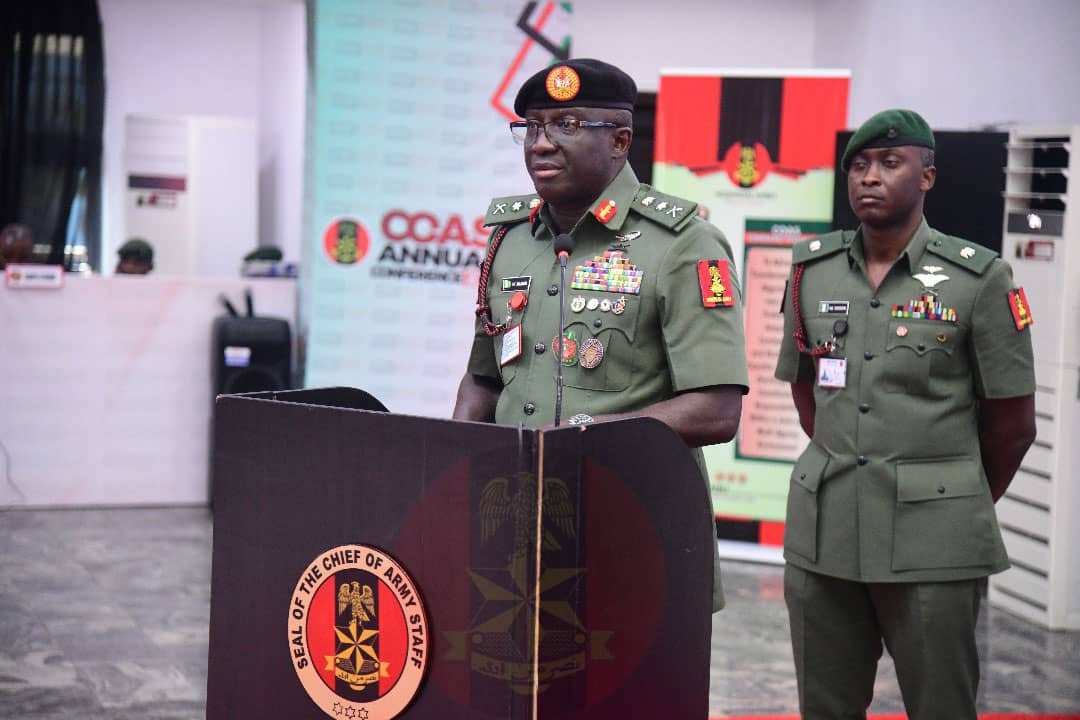
When the Chief of Army Staff (COAS), Lt Gen Waidi Shaibu, brought down the curtain on the 2025 Annual Conference of the Nigerian Army, what emerged from Nebo Hall, Abalti Barracks, Lagos, was a reform agenda which if faithfully implemented, could recalibrate the Army’s operational effectiveness and moral contract with its personnel.
At the heart of the conference was a sober acknowledgment that the character of warfare has evolved, and so must the institutions tasked with confronting it. Asymmetric warfare demands a new skillset.
The COAS’s insistence on aligning the Army more closely with his command philosophy: professionalism, adaptability, combat readiness and resilience, reflects an understanding that modern armies win not by brute force alone, but by agility, intelligence and cohesion within joint and multi-agency frameworks.
Perhaps the most consequential outcome of the conference is the planned overhaul of training across Nigerian Army schools.
For too long, training reforms in many developing militaries have lagged behind operational realities. The renewed emphasis on realistic, mission-focused training is therefore not just commendable; it is existential!
Wars are won in training grounds long before the first shot is fired, and the Army’s decision to recalibrate curricula, especially in Special Forces training and Army Aviation employment, points to a willingness to learn, adapt and stay ahead of adversaries who themselves are constantly evolving.
Equally significant is the renewed focus on intelligence, surveillance, target acquisition and reconnaissance (ISTAR), alongside cyber operations. These are the backbone of contemporary military success.
In an era where enemies hide among civilian populations, exploit digital spaces and strike asymmetrically, superior intelligence and technological integration can mean the difference between precision and collateral damage, between success and strategic setback.
The conference’s call for innovation at all levels of command suggests an Army increasingly aware that tomorrow’s battles will be fought as much with data and algorithms as with boots and bullets.
Yet, beyond tactics and technology, the conference struck a critical moral note: troop welfare. This is where reform agendas often falter, drowned out by operational exigencies and budgetary constraints.
Read Also:
The Nigerian Army’s renewed commitment to addressing accommodation shortages, renovating barracks and expanding post-service housing options deserves particular attention. An Army that demands sacrifice must also demonstrate care.
Soldiers who are unsure of their families’ welfare or their own post-retirement dignity cannot be expected to operate at peak effectiveness in life-and-death situations.
The planned commissioning of housing and commercial infrastructure projects in Ibadan, such as the Affordable Home Ownership Option for All Soldiers at Akobo and the post-service housing shopping complex in Eleyele, goes beyond symbolism. These initiatives represent an institutional recognition that welfare is not charity; it is strategy.
Well-housed, motivated and future-secure troops are more disciplined, more loyal and more resilient under pressure. In the long run, welfare investments pay operational dividends.
Critically, the conference also reaffirmed the Army’s commitment to civil authority and constitutional responsibility, acknowledging the sustained support of the President and Commander-in-Chief. This balance: professional military autonomy on one hand and democratic subordination on the other, is essential in a republic. It reassures the public that reform is not about power accumulation, but about service delivery in its most solemn form: national defence.
Of course, conferences do not win wars. Implementation does. The true test of the 2025 Annual Conference will lie in how swiftly resolutions are translated into policy, doctrine and action. Nigerians have seen many well-articulated plans falter at the altar of bureaucracy, funding gaps or institutional inertia. The promise of a formal summary of resolutions and a clear implementation pathway is encouraging, but vigilance will be required to ensure momentum is not lost once the conference banners are packed away.
As the Army looks ahead to milestones such as new housing project commissions and the passing-out parade of recruits in Osogbo, it is clear that 2026 is being framed not as business as usual, but as a year of consolidation and execution.
In a nation yearning for improved security and restored confidence in state institutions, the stakes could not be higher.
Ultimately, the significance of the Lagos conference lies in its candour and ambition. It suggests an Army willing to confront its limitations, invest in its people and retool for a future defined by complexity rather than certainty.
If the Nigerian Army can move decisively from talk to tactics, from resolutions to results, then the 2025 Annual Conference may well be remembered as the moment reform stopped being an aspiration and started becoming a reality.
*Chidi Omeje is the publisher of Security Digest (www.securitydigestng.com)