COAS Calls for Multi-Domain Warfare as Army Expands to 12 Divisions
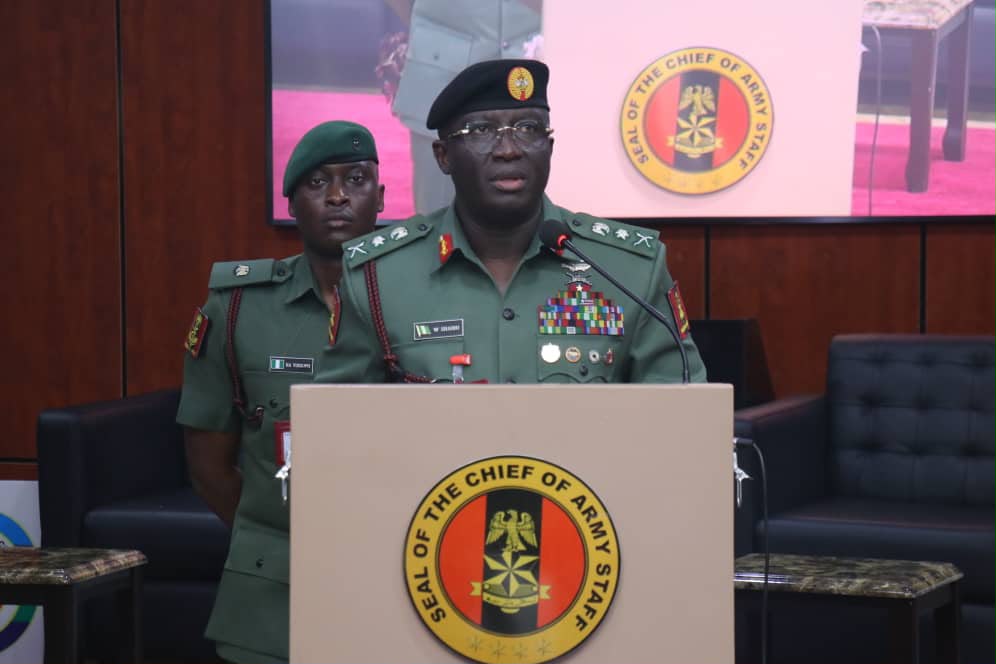
The Chief of Army Staff (COAS), Lieutenant General Waidi Shaibu, has called for enhanced joint operations, intelligence sharing and multi-domain integration among the Armed Forces of Nigeria and other security agencies, saying the country’s evolving security threats require coordinated military capabilities and stronger inter-agency collaboration.
Shaibu made the call on Monday, October 12, 2026, while addressing participants at the graduation lecture of Army War College Course 10/2026 in Abuja. He said the increasingly complex nature of modern warfare demanded a coordinated approach that harnesses the complementary strengths of the military and other security institutions to achieve decisive operational outcomes.
The Army Chief described the ongoing expansion of the Nigerian Army from eight to 12 divisions as a strategic initiative aimed at strengthening territorial coverage, improving operational responsiveness and enhancing the military’s capacity to address emerging security threats across the country.
He, however, stressed that the expansion was not merely about increasing the number of formations and personnel, but about building a more professional, adaptable, combat-ready and resilient force capable of operating effectively within joint and multi-agency frameworks.
According to him, the success of the expanded force will depend on the effective integration of trained personnel, modern technology, actionable intelligence, robust logistics and efficient command-and-control systems.
He maintained that additional formations and numerical strength must translate into superior combat capability, operational flexibility and measurable improvements in national security.
Shaibu also charged military commanders to embrace innovative approaches to warfare by integrating intelligence, technology, information operations and combat capabilities across multiple operational domains.
Read Also:
He emphasised that operational effectiveness must be underpinned by professionalism, discipline and respect for the rule of law, noting that these principles remain critical to sustaining public confidence and institutional credibility.
The COAS urged participants of Course 10/2026 to apply the strategic knowledge and leadership competencies acquired during their training to practical operational challenges, particularly in improving military effectiveness, strengthening inter-agency cooperation and advancing the transformation of the Nigerian Army.
Delivering the graduation lecture, titled “Winning in Complex Security Environments: Reimagining the Nigerian Army Force Structure for Multi-Domain Operations,” former National Security Adviser, Major General Babagana Monguno (rtd.), called for a fundamental reorientation of military structures, doctrines and operational concepts to address emerging security threats.
Monguno highlighted the growing importance of integrating land, air, cyber and information capabilities in contemporary warfare, observing that emerging technologies, including unmanned aerial systems, artificial intelligence and digital communication platforms, were rapidly changing the character of military operations.
He advocated sustained investment in technological innovation, intelligence integration, institutional reforms and continuous professional military education to equip commanders with the knowledge and competencies required to operate in increasingly complex and contested security environments.
Earlier, the Commandant of the Army War College Nigeria, Major General Umar Alkali, commended the COAS for his continued support for the institution’s efforts to develop operational-level commanders and strategic leaders.
Alkali said participants of Course 10/2026 had undergone rigorous professional training designed to strengthen their critical thinking, operational planning and leadership capabilities for contemporary military operations.
The graduation lecture formed part of activities marking the completion of Army War College Course 10/2026 and underscored the Nigerian Army’s commitment to developing intellectually equipped, technologically adaptable and operationally proficient commanders capable of fulfilling the military’s constitutional responsibilities.