Inside Giwa Barrack’s Joint Investigation Centre Where Terror Suspects Are Processed
By Chidi Omeje
Far from being just another military detention site, the Joint Investigation Centre at Giwa Barracks in Maiduguri has quietly evolved into one of the most critical pillars of Nigeria’s counter-insurgency campaign in the North-East where arrests made in the course of the counter insurgency operations are painstakingly transformed into prosecutable cases within the justice system.
This reporter was among the defence correspondents that were shown around the sprawling facility tucked inside the Giwa Barrack’s in down town Maiduguri, Borno State capital.
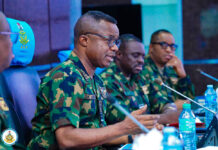
Explaining how the centre operates, the facility’s commander, Brig.-Gen. Yusuf Audu, represented by Capt. Obinwale, described a system that is increasingly structured, coordinated, and gaining momentum.
The completion of investigations into about 1,450 terrorism-related cases, alongside the transfer of over 500 suspects for trial, many of whom have already been convicted, offers a window into a process that is often invisible to the public but essential to sustaining long-term security.
At its core, the JIC functions as the bridge between kinetic military operations and judicial accountability. Every suspect brought in from the frontlines or sidelines of the fight against Boko Haram and ISWAP enters a structured pipeline, one that attempts to answer a fundamental question: who should be punished, who can be rehabilitated, and who can safely return to society?
This triage system: prosecution, rehabilitation, or reintegration, is not arbitrary. It is the product of layered investigations, legal scrutiny, and intelligence analysis carried out by a rare coalition of institutions. Within Centre, personnel from the Nigerian Army, Police, DSS, Defence Intelligence Agency, Correctional Service, NSCDC, NDLEA, and Immigration Service work side by side with legal experts from the Office of the Attorney-General of the Federation. In a conflict often defined by fragmentation, the centre represents an unusual but necessary convergence.
What emerges is a more nuanced picture of counter-terrorism: not just a war of bullets, but one of evidence, documentation, and due process.
Read Also:
The facility’s design reflects this dual mandate. Detainees are not simply held; they are processed, documented, medically screened, psychologically assessed, and in many cases, prepared for eventual reintegration or prosecution in the court of law.
Segregated housing for women and children, educational support for minors, and healthcare interventions, including treatment for infectious diseases such as tuberculosis, shows an attempt, however imperfect, to balance security imperatives with humanitarian considerations.
Support from international partners such as the International Committee of the Red Cross, the International Organization for Migration, UNICEF, and the United Nations Office on Drugs and Crime has further shaped the centre’s evolution. From biometric data systems and evidence storage facilities to water supply and healthcare support, these collaborations have helped standardise procedures and improve both efficiency and oversight.
Equally significant is the facility’s investment in what happens after detention. Skill acquisition programmes ranging from tailoring and farming to bakery operations, are strategic tools aimed at reducing recidivism and breaking the cycle of radicalisation. In a region where economic deprivation often feeds insurgency, these interventions hint at a longer-term stabilisation strategy.
Yet, beneath the progress lies a set of persistent challenges that reflect the complexity of the conflict itself. Securing witnesses from terrorised communities remains difficult, as fear of reprisal continues to silence critical testimony. Delays in the judicial process also mean that some detainees spend extended periods in custody, testing both the system’s capacity and its commitment to due process.
Even so, the Giwa centre’s growing record of processed and prosecuted cases signals a shift from reactive counter-insurgency to a more institutionalised approach, one that seeks to ensure that arrests on the battlefield do not end in legal limbo.
In a conflict where narratives are often dominated by casualty figures and territorial gains, the work being done inside the Joint Investigative Centre at the Giwa Barracks tells a different story: that lasting victory against insurgency depends not only on military success, but on the strength of the systems that follow it.