
Why Nigeria Cannot Ignore JNIM’s Advance into Benin Republic
By Chidi Omeje
The growing presence of Jama’at Nusrat al-Islam wal-Muslimin (JNIM) in northern Benin Republic should be a wake-up call for Nigeria and its regional partners. What was once perceived as a distant Sahelian threat is now steadily moving southward, bringing violent extremism closer to the Gulf of Guinea and, by extension, Nigeria’s economic heartland.
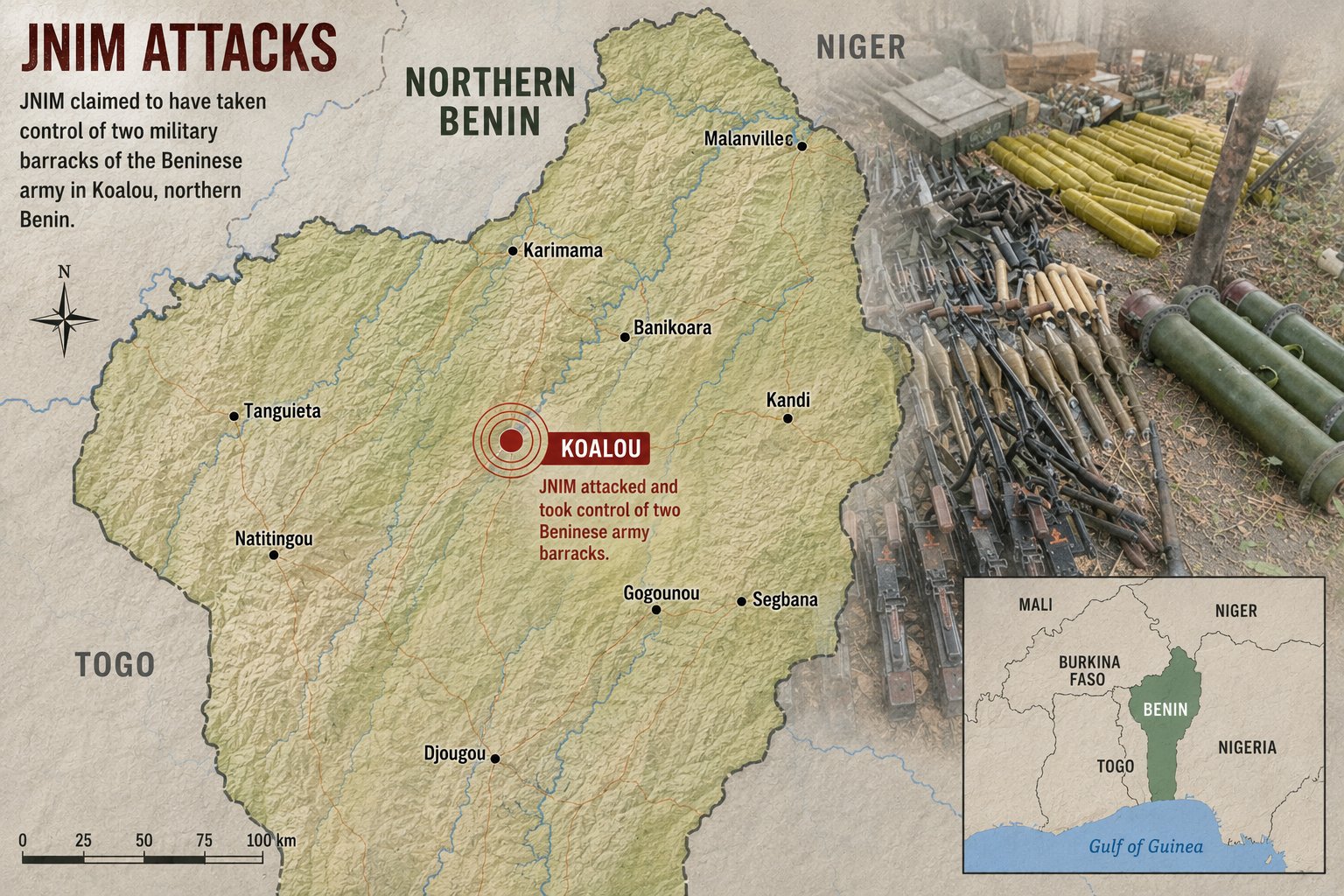
Recent reports that JNIM fighters have overrun two Beninese military barracks in Koalou, northern Benin, underscore the urgency of the situation. This is not merely Benin’s problem. It is a regional security challenge with potentially far-reaching consequences for West Africa.
For years, terrorist groups operating in the Sahel have exploited weak border controls, vast ungoverned spaces, and fragile state presence to expand their influence. Having entrenched themselves in parts of Mali, Burkina Faso and Niger, these groups are now probing southward into coastal states. Northern Benin has emerged as one of their latest targets.
The danger lies not only in territorial expansion but in the establishment of operational corridors that could eventually threaten major population and economic centres. If left unchecked, today’s attacks in northern Benin could become tomorrow’s security concerns for southwestern Nigeria. The prospect of extremist networks inching closer to strategic cities such as Lagos should concern every policymaker and security planner.
Read Also:
This is why the ongoing engagement between Nigerian and Beninese military leaders is both timely and necessary. However, dialogue alone will not stop a determined terrorist movement. The time has come to translate consultations into concrete action.
Nigeria possesses one of the most capable air forces in the region, with extensive experience in intelligence, surveillance, reconnaissance and precision strike operations against terrorist groups. In partnership with Benin, these capabilities can be leveraged to disrupt JNIM’s movement, target its logistics networks, and deny it the freedom to establish permanent sanctuaries in northern Benin.
Beyond airpower, both countries should establish robust intelligence-sharing mechanisms, joint planning cells, coordinated border patrols and rapid-response frameworks capable of addressing emerging threats before they metastasize into full-scale insurgencies.
History has shown that terrorist groups are easier to defeat when confronted early. Once they become entrenched within local communities and establish sophisticated support networks, the cost of dislodging them rises exponentially.
The battle for northern Benin is therefore not simply about protecting one country’s territory. It is about defending the security architecture of the entire Gulf of Guinea region. Nigeria and Benin have an opportunity to act decisively and collectively before JNIM gains a stronger foothold.
The lesson from the Sahel is clear: delay favours the terrorists. Early intervention favours peace. The choice should be obvious.
*Chidi Omeje is the Publisher/Editor-in-Chief of Security Digest (www.securitydigestng.com)