
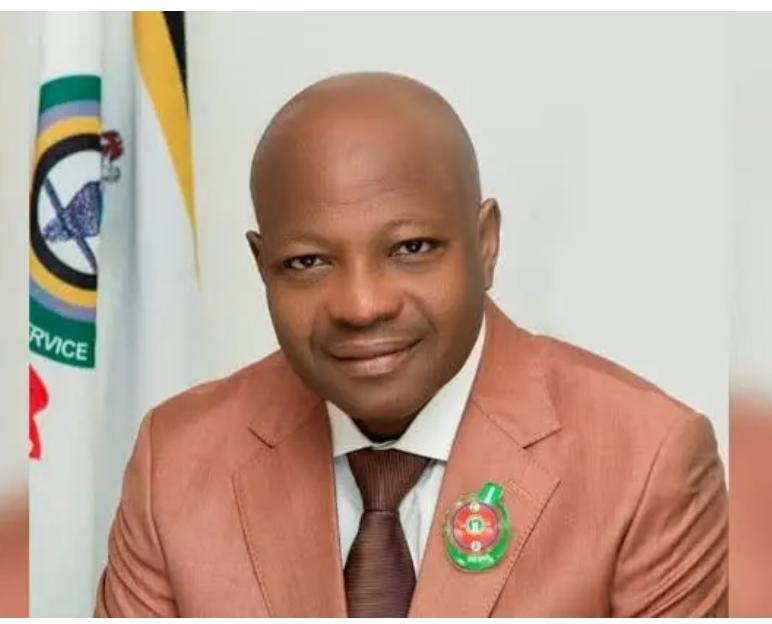
Oluwatosin Ajayi: The Quiet Revolution Inside Nigeria’s Secret Service
By Chidi Omeje
“Power announces itself with noise; reform proves itself in silence.”
Two years into his tenure as Director-General of the Department of State Services (DSS), Oluwatosin Ajayi is making a case for a different kind of leadership for Nigeria’s premium intelligence asset: one that is tough on terrorism and organised crime, but more restrained in the exercise of state power; one that pursues convictions rather than headline arrests, cooperation rather than inter-agency rivalry, and public trust rather than institutional intimidation. That is the real significance of Ajayi’s tenure.
He is not an outsider attempting to impose change on the DSS. He is its own creation. He joined the Service as a cadet officer 36 years ago and rose through its ranks to become its Director-General; the first cadet of the organisation to reach its summit.
He knows the system from within: what it can do, where it falls short and where its habits have sometimes worked against it. His answer has been neither to repudiate the past nor to defend it reflexively, but to change what needs changing. The clearest evidence is the way he has sought to redefine the use of power itself.
Under Ajayi, the principle is straightforward: not every dispute is a security matter, and not every disagreement requires an arrest. For him, civil disputes should be resolved through civil processes. Where the Service disagrees with a journalist or civil society organisation, it can seek clarification, demand a correction or go to court. The coercive powers of the state should be reserved for genuine threats and criminal conduct.
In a country where security agencies have often been criticised for blurring that distinction, this is more than administrative reform. It is a change in institutional culture. And that may prove to be Ajayi’s most important contribution to the DSS.
For years, the DSS was often portrayed as an institution where the arrest room came before the courtroom, and where allegations could sometimes become punishment before evidence was tested. Ajayi appears determined to change that culture. His operating principle is refreshingly straightforward: not every dispute is a security matter, and not every disagreement requires an arrest. That may sound elementary in a democracy. But in an intelligence organisation accustomed to operating behind a veil of secrecy, it represents a significant cultural shift. And the evidence of that shift is difficult to ignore.
Ajayi has been recognised and appreciated by the International Press Institute, the Nigeria Union of Journalists and the Broadcasting Organisations of Nigeria, institutions whose relationship with the security establishment has not always been comfortable. The irony is hard to miss: a DSS Director-General receiving plaudits from the media.
But perhaps his most consequential reform is one that has received less attention: the decision to acknowledge when the state gets it wrong.
Ajayi has also embraced what may be described as restorative justice: when DSS personnel cause unjustifiable harm, the Service should apologise, compensate the victim and, where possible, help restore what was lost. Consider the Jos businessman mistakenly shot in 2016. A court awarded him ₦10 million, but the judgment was not implemented for years. Ajayi reopened the matter after becoming DG, accepted the Service’s responsibility, provided medical treatment and approved another ₦10 million to help rebuild the man’s livelihood.
There are other cases: an Abuja businesswoman mistakenly arrested during an anti-bunkering operation; a couple detained on mistaken terrorism allegations; students whose phones were damaged during a counter-kidnapping operation. In each case, the underlying message is the same: the power of the state does not make the state infallible. That is an important lesson for any security institution, and it is also smart intelligence policy.
Ajayi understands that the greatest asset of an intelligence service is not always a satellite, surveillance system or sophisticated database. It is people. Citizens who trust security agencies are more likely to volunteer information. Communities that do not feel collectively criminalised are more likely to cooperate. People who believe that the state will correct its mistakes are less likely to regard it as an enemy. In Ajayi’s formulation, human intelligence begins with human dignity. That philosophy also explains his interest in reaching vulnerable Nigerians, including young people from orphanages, and his emphasis on humanitarian interventions across communities.
Read Also:
There is a strategic calculation beneath the humanitarianism: reduce alienation and you reduce the space in which violent extremism and organised crime can thrive. But Ajayi’s reform agenda is not simply about being softer. On the contrary, he has presided over a DSS that appears increasingly determined to be tougher where toughness is justified, and smarter about where it is applied.
The clearest example is the emphasis on convictions rather than mere arrests. For too long, Nigerian security agencies have sometimes celebrated the arrest of suspects as though arrest itself were proof of guilt. Ajayi’s approach is different: investigate properly, gather evidence, prosecute diligently and secure convictions. That approach has produced terrorism convictions resulting in life imprisonment, lengthy prison sentences and death sentences in some cases.
The Service has also reported the interception and recovery of hundreds of sophisticated firearms and more than 300,000 rounds of ammunition, alongside operations targeting terrorist and kidnapping networks. The point is not the statistics alone. It is the philosophy behind them: disrupt the network, dismantle its supply chain and take the case to court. That is what a professional intelligence service should do.
Ajayi has also taken aim at another longstanding weakness in Nigeria’s security architecture: institutional rivalry. His prescription is blunt. If agencies compete for glory, blame leadership. If they cooperate, credit leadership.
Under his watch, the DSS has increasingly emphasised intelligence sharing and joint operations involving the military, police, NSCDC, vigilantes and foreign partners. The Oriire school children and teachers abduction operation in Oyo State is a useful illustration. Rather than one agency claiming the victory, the operation was acknowledged as a collective effort. Nigeria’s security threats are too complicated for one agency to defeat alone.
The intelligence chief is equally candid about the limits of intelligence. He does not pretend that the DSS can prevent every attack. Nor does he hide behind the hundreds of threats that may have been disrupted but never became headlines. His acknowledgement that a parent whose child has been kidnapped does not care about attacks that were prevented elsewhere is perhaps one of the most sober observations from his modus operandi.
For him, a prevented attack is invisible. A kidnapped child is not. That is why his advocacy for stronger local security structures, including state police and forest guards, is significant. Intelligence without the capacity to respond quickly can become little more than information sitting in a file.
And there is another issue on which the DSS chief deserves credit: his insistence that crime must not be ethnicised. Nigeria cannot criminalise an ethnicity because some members of that community commit crimes. Criminality has no tribe, religion or political party. The task of the state is to identify the criminal, prosecute the criminal and protect the innocent, without collective punishment.
Ajayi’s explanation of the country’s worsening insecurity points to something deeper: the retreat of governance from remote communities. Where government disappears, criminals move in. Where forests become ungoverned spaces, kidnappers establish camps. Where communities lose legitimate security structures, criminal networks fill the vacuum. The answer, according to hin, cannot be guns alone. It must include governance, intelligence, community policing, justice and the restoration of public confidence. That broader understanding may be the most important feature of Ajayi’s leadership. He is not presenting the DSS merely as an organisation that arrests people. He is rather trying to turn it into an institution that anticipates threats, builds partnerships, gathers intelligence, respects the law, protects its credibility and learns from its mistakes.
The transformation is however not complete. Indeed, Nigeria’s security challenges remain daunting. Terrorism, kidnapping, banditry, communal violence, arms proliferation and ungoverned spaces continue to test the country. Ajayi himself concedes that the Service must do more.
That concession is important. The true measure of a security chief is not how loudly he declares victory, but how honestly he confronts the threat. Two years into his tenure, Ajayi’s most consequential achievement may therefore not be any single arrest, weapons seizure or conviction. It may be something less dramatic but far more enduring: the attempt to change the culture of a powerful institution.
He is certainly determined to make the DSS tough without making it reckless. Secretive without being unaccountable. Powerful without becoming arbitrary, and feared by criminals without being feared by innocent citizens. That is a difficult balance but after 36 years inside Nigeria’s secret service, Oluwatosin Ajayi appears to understand something fundamental: the ultimate strength of an intelligence organisation is not how much power it possesses, but how effectively it earns the trust of the people it is sworn to protect.
That is the quiet revolution underway at the DSS and Mr Oluwatosin Ajayi is behind it. Kudos to him.
*Chidi Omeje is the publisher of Security Digest and member of Zagazola Media Network