OPWS Commander Blames Criminality, Harmful Narratives for Insecurity in Benue
By: Zagazola Makama
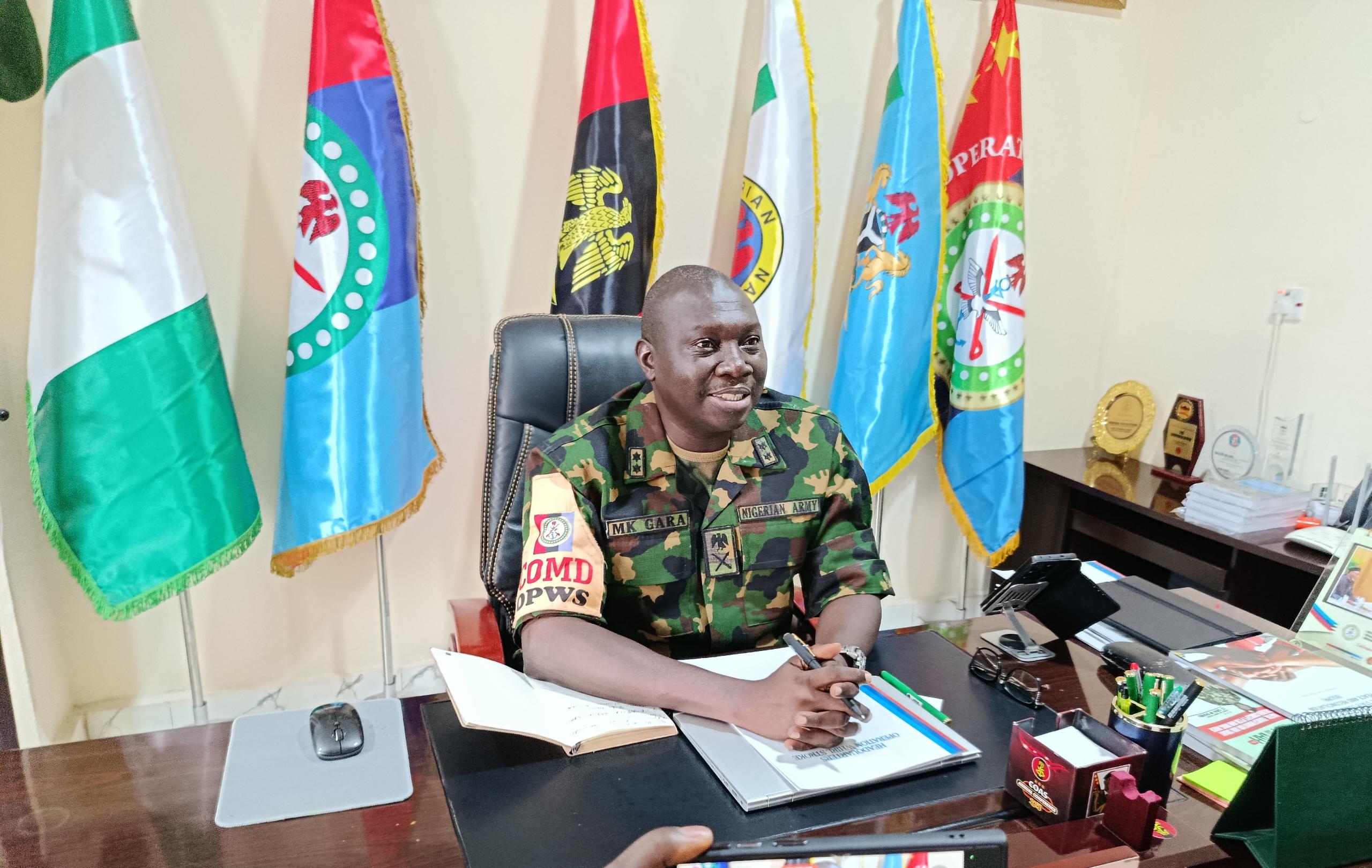
Maj Gen Moses Gara, The Commander of Joint Task Force (JTF) Operation Whirl Stroke (OPWS) has identified criminality, misinformation and poor road infrastructure as major factors complicating security operations in Benue and neighbouring states.
The commander stated this while speaking on the security situation in Benue, where the task force is conducting operations against criminal elements.
According to him, troops have continued to intervene in communal disputes and farmer-herder tensions to prevent violence and promote peaceful coexistence among communities.
He cited a recent intervention in the Bajimba axis of Guma Local Government Area of Benue, where a dispute over a fish pond escalated into violence, leading to the destruction of property and threats of further attacks.
“We deployed troops to the area, engaged the parties involved and encouraged dialogue. The situation has since calmed down,” he said.
The commander, however, noted that inadequate road infrastructure remains a major operational challenge, making it difficult for security personnel to respond swiftly to distress calls from remote communities.
He said poor accessibility to many rural areas often delays emergency responses, particularly during periods of heightened tension.
Despite the challenge, he said the task force had continued to rely on air surveillance and support from the Nigerian Air Force to monitor volatile locations and respond to emerging threats.
According to him, military aircraft have on several occasions assisted in monitoring security situations and preventing further destruction in conflict-prone areas.
The commander also highlighted what he described as a persistent and damaging narrative that insecurity in Benue is part of a deliberate plan to displace indigenous communities and take over their lands.
Read Also:
He said the narrative had become deeply entrenched across different segments of society and was contributing to tensions within affected communities.
“There is a very strong perception in some quarters that there is an organised agenda to displace local populations and occupy their ancestral lands.
“From our operational experience on the ground, that narrative presents one of the greatest challenges to peacebuilding efforts because it fuels mistrust and sometimes encourages retaliatory actions,” he said.
The commander argued that the realities observed during military operations do not support claims of a systematic occupation of displaced communities.
He said troops had visited numerous communities affected by violence and displacement but had not found evidence of abandoned settlements being occupied by herders.
“I have personally visited several displaced communities. We have not seen situations where displaced indigenous communities were replaced by herders occupying those settlements,” he said.
The commander acknowledged, however, that cases of farmland destruction by livestock had occurred in some areas.
He described some of the incidents as “malicious grazing”, often carried out as reprisals following attacks on herders or cattle rustling incidents.
According to him, such actions contribute significantly to the cycle of violence and deepen divisions between communities.
The commander called on community leaders, opinion moulders and residents to avoid inflammatory narratives and instead support efforts aimed at fostering dialogue and peaceful coexistence.
He stressed that lasting peace in the region would require cooperation among communities, security agencies and government institutions.
The commander also urged residents to continue providing credible information to security agencies, assuring them that intelligence supplied by the public remains critical to preventing attacks and dismantling criminal networks operating in the region.