OPWS Commander Calls for Stronger Government-Community Collaboration, Warns Against Politicisation of Security Efforts
By: Zagazola Makama
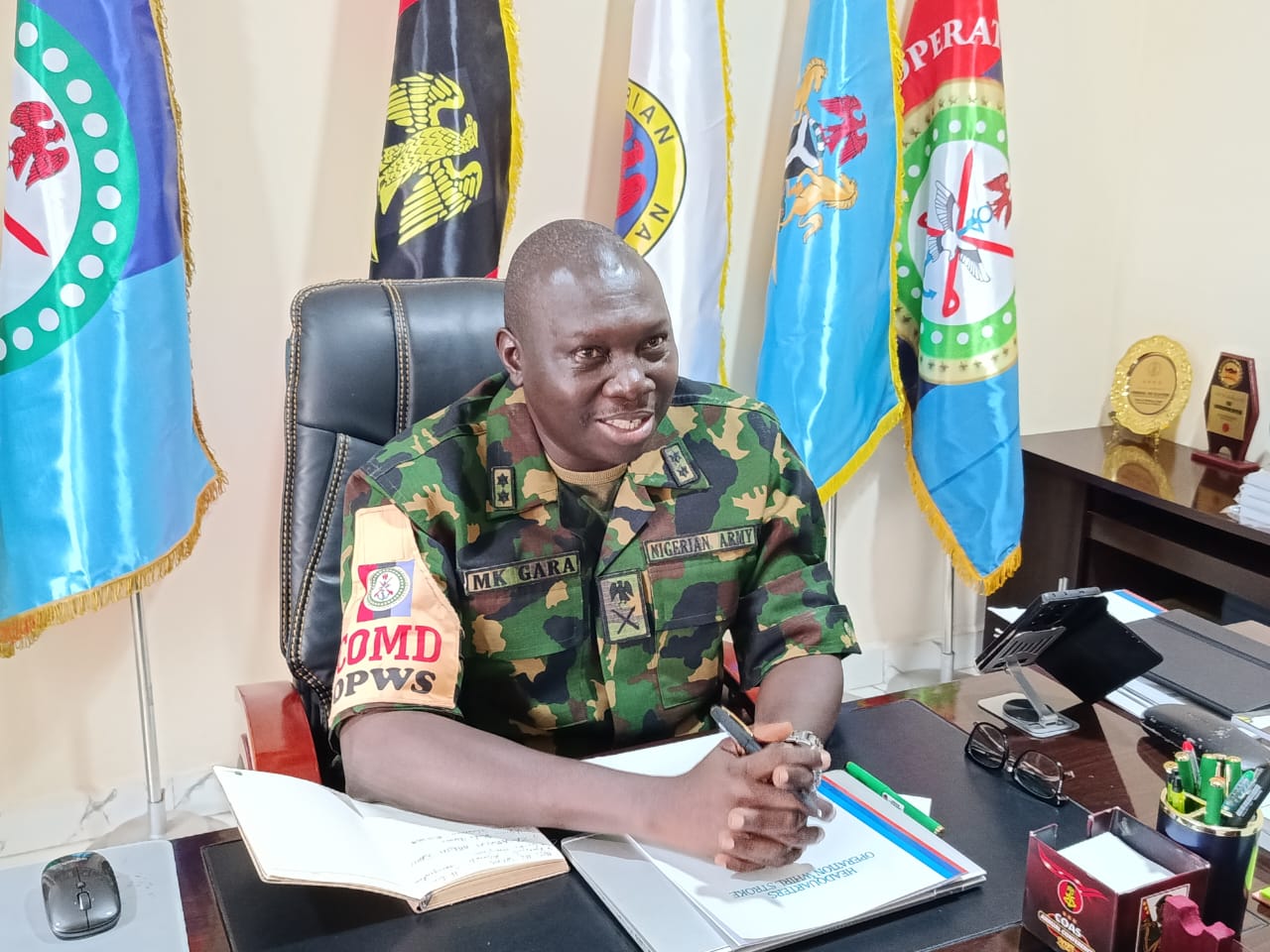
Maj Gen Moses Gara, The Force Commander of Joint Task Force, Operation Whirl Stroke (OPWS), has called for stronger collaboration between government institutions, security agencies and local communities in addressing insecurity in Benue, Nasarawa and Taraba States.
The commander, while speaking on ongoing security operations in the region on Saturday, said that while progress was being made, efforts were being constrained by what he described as politicisation of peacebuilding initiatives and conflicting public narratives.
He noted that government-driven engagement frameworks, including peace and reconciliation mechanisms, were essential for sustainable stability but often faced resistance at different levels.
“The reality is that government efforts are also constrained by narratives around the conflict. It places everyone in a difficult position, almost like walking a tightrope,” he said.
The commander cited the establishment of a Peace and Reconciliation Commission and a 2026–2030 strategic peace plan developed with support from international partners as part of ongoing institutional responses to insecurity.
He said the initiative was designed to promote dialogue among conflicting communities and strengthen long-term peacebuilding efforts in the affected states.
According to him, the initiative had received mixed reactions, including resistance in some quarters, even before its formal implementation.
“In some instances, you see hesitation among stakeholders to be visibly associated with dialogue platforms, even when such platforms are meant to promote peace,” he said.
The commander, however, noted differences in the level of support received across the three states under OPWS operations.
Read Also:
He said that while Nasarawa and Taraba States had demonstrated relatively stronger institutional backing for security and peace initiatives, the situation in Benue remained more complex.
“In Taraba, you can feel the support. In Nasarawa, there is also visible cooperation. But in Benue, the situation is more complex and sometimes uncertain,” he said.
He explained that despite operational successes recorded by troops, including the rescue of abducted victims and recovery of weapons during recent raids on criminal hideouts, such achievements were not always adequately reflected in public communication.
The commander said, for instance, that a recent dawn operation led to the rescue of kidnapped victims, recovery of arms and the neutralisation of two suspected abductors, while a key suspect reportedly escaped.
He expressed concern that such operational outcomes were sometimes underreported, noting that effective public communication was essential in strengthening confidence in security efforts.
He also emphasised the importance of continuous engagement with political and traditional authorities to bridge perceived gaps in governance and security coordination.
The commander further disclosed that OPWS had undertaken several civil support initiatives, including the renovation of a primary school and the donation of learning materials to pupils in underserved communities.
He said such interventions were aimed at complementing civil authorities, particularly in areas where basic infrastructure such as schools and water supply remained inadequate.
According to him, addressing insecurity requires a holistic approach that combines military operations, governance interventions and community development.
“We cannot succeed without the support of government and the people. That cooperation is essential for lasting peace,” he said.
The commander reaffirmed the commitment of OPWS to sustaining operations against criminal elements while deepening collaboration with stakeholders across the affected states.